Thursday, March 1, 2012

Satirizing Optimism

This week we finished our unit on satire on my English class and I feel that reading Candide introduced me to what satire is and made it into one of my favorite genres of literature. Voltaire criticizes several aspects of society, but his ultimate mockery is that life is destined to be miserable and that the world is not just. As I learned in class, satire is made up of four elements: hyperbole, irony, absurdity and a target, all which can be seen in Candide and help Voltaire mock the European society during the Age of Enlightenment and express his pessimistic philosophy. Although many times these elements are put all together, I will try to show how Voltaire used each in the book to mock his target.


To start off, hyperbole in Candide is ineluctable as it is what makes Voltaire able to satirize life. As he was trying to show that life is not fair, he used exaggerated situations to make it visible to the reader. Hyperbole can be seen simply in the miserable lives of all the characters, who get constantly imprisoned, attacked and simply fall in the misfortunes of the world, which highlight what Voltaire has to say about his targets. Exaggeration can be seen throughout the book, from the weight of the Baroness and the unwillingness of getting married because of the number of quarterings of the Baron's sister in the first page, to the overly unreasonable logic of Pangloss in the last page. Many of the characters suffer from too many unlucky events, like the stories each character tells Candide as they meet, like the old woman, or the Baron and Pangloss towards the end. Voltaire shows how unreasonable the Inquisition was by showing how the auto-da-fé was made under ridiculous reasons. In order to contrast the flaws of Europe and America with his idealistic society, Voltaire makes Eldorado a complete utopia, where people have huge amounts of wealth and live simply perfectly. To wrap up hyperbole, in Candide many of people's thoughts are made overemphasized to show how illogical they were, like that chocolate justified syphilis from the new world, or that noses are made so that people can wear spectacles.


The situations the characters face are an example of hyperbole as they move around the world and find obstacles and problems everywhere. 

Irony in Candide is mainly focused on the situations, to show that the ideas of the Age of Enlightenment were many times unreasonable. He mocks ideas like that everything was made for a reason, like that noses were made for people to wear spectacles or the constantly mentioned "cause and effect" in situation where things simply happened because of the unfairness of the world. It's also ironic that Pangloss, completely optimistic has such bad luck. All throughout Candide's life, he suffers from the most unlucky miseries, but as his name implies, is naïve and thus fails to see that the world is unfair. It is as well ironic that he struggles all his life to get Cunégonde and when he finally does, she is ugly and he doesn't really want to marry her. Irony is also used in specific targets such as the Catholic Church, as Pope Urban X has a princess daughter, Brother Giroflée is homosexual and the Church, instead of following God's will, is very cruel and irrational in things like the Inquisition. 


As it can be seen in the cover of this edition, ironically Candide is optimistic while he lives in misery. 
Absurdity in Candide is also seen from the very beginning, where a second cover page says that the book was translated from the German by Dr. Ralph, a complete absurdity. Throughout the book you can see that Voltaire uses small unrelated details that simply  give you a laugh sometimes and contribute to the satire. For instance, things like mentioning the height of Candide in one of the first chapters, having two Guarani girls be infatuated with two monkeys or saying that Brother Giroflée finally became "Turk" are some cases where Voltaire adds unrelated and unexpected details that make his work more humorous. Many times he also over explains what is happening and characters have unusual responses, like when Cunégonde is telling Candide how she was raped and imprisoned by the Bulgars, and all he replies is that he'd be interested in seeing her wound. Voltaire combines many of the elements of satire, like naming the German town Thunder-ten-Tronckh, which is partly absurdity but mostly hyperbole. The same happens with Pangloss' job, being a métaphysico-théologo-cosmolonigologist


Details like that is was translated by Dr. Ralph are an example of  how Voltaire uses absurdity to mock his target, in this case the Germans. 


As it can be seen in the previous paragraphs, Voltaire uses all these elements of literature to criticize a target, as satire does. He mainly shows that the world is not fair and that we have to toil to survive it, as he explains in the last chapter, but along the way he mocks many other things, like feudalism, or military, religion, infatuation, the use of wealth or the whole of Germany. Throughout Candide, Voltaire ridicules feudalism and the illogical wars or social segregation it brought. He makes fun of the irony of religion and the overrated romantic relations. Many times he shows that wealth wasn't being used well (and all those things that triggered the French Revolution) and the irrational philosophies of the enlightened, many times in Germany. In conclusion, as the book's title directly says, Voltaire shows that the world is unfair, while he mocks optimism, basically by satirizing the life an optimistic yet miserable person.  

Sunday, February 26, 2012

Candide in Six Words

Candide:
Doomed though happy, worked to satisfaction. 


Pangloss:
Uselessly enlightened, was blind to reality.

Cacambo: 
Though moral, victim of humanity's faith. 


Cunégonde: 
Infatuated throughout life, ended doing nothing. 

Martin:
Couldn't really see behind solid pessimism. 


Old woman:
Pushed to death, managed to survive.

Sunday, February 19, 2012

Humans are Perfect

At the end of chapter XXI, Candide asks Martin whether he thinks that humans have always fought each other. Martin replies with a question, asking him if hawks have always eaten pigeon, to which Candide answers that they have. Martin says that as hawks haven't changed, neither have humans. Finally Candide responds that the difference is that humans have "Free Will."

I can't say that I completely agree with what Martin said, as humanity has somewhat improved, but I did find Candide's reaction, a very human reaction. People for some reason always tend to believe that the human race is absolutely superior to any other, which quite frankly really bothers me. In terms of dominance, survival, intelligence, or the way we relate to each other humans are certainly superior than other animals, but that doesn't mean we're not animals or that other animals are bad. In a previous blog post I gave my opinion on bull fighting, and I don't mean to sound very insisting but animal cruelty and unfairness towards them is unacceptable.


I'll be brief with this, so to start off, during the last years an increasing number of scientific studies have shown that animals do have feelings, inter-specie relationships, etc (all those obvious things). Animals are not able to make advanced technology, communicate in a very elaborate way, but that doesn't mean people should underestimate them and feel worthier than them. As an owner of four dogs, I can tell for sure that they have personalities, relationships between them, an authority, a family-like structure and understand how humans feel about them. Treating animals badly affects them, even though they can't express them in human words. I don't like humans that are in love with their genetics and feel that evolution gives them perks. People who treat animals badly are highly likely to also be violent with humans. Again, I don't want to sound insistent, or a radical like PETA, but unless people want to be statistically related to criminals, they shouldn't be mean with animals. 


Some links you should check out: 
http://www.humanesociety.org/issues/abuse_neglect/qa/cruelty_violence_connection_faq.html
http://icb.oxfordjournals.org/content/40/6/883.full  (notice how they refer to "non-human animals")

El Dorado: Quechua for Utopia?


When Spanish explorers arrived to South America they soon heard about the legend of El Dorado. Their ambition made them imagine a city made out of gold and jewels, where their wildest dreams would come true from all the money they would get. Many made expeditions to look for the legendary city but, whether in Ecuador, Colombia, or Guyana, were always unsuccessful. Nowadays some people relate it to the tribal ceremonies that took place in Guatavita, where an indigenous chief was covered in gold dust as people threw golden objects into a lake. It is evident that the golden city does not exist, so as I read Candide, that made me question the significance this legend has. Colonizers probably exaggerated the whole story, but the Indians probably did have a myth with this utopian city were everything is perfect.

As seen in the case of El Dorado, societies create their own imaginary paradise. Whether it was in the Old World or the New World, human nature made people create one. People in India created Nirvana, Catholics had Heaven and Indigenous tribes had each their equivalent. This probably happens because people, no matter where, need to look after something, or a reason to be optimistic.


So coming back to Candide, in class we discussed whether the world was just or not, and what Voltaire would've said about that. At first I thought the world was fair if made it that way, but as I've thought further into it, I understand what that question truly mean, and that the world is unfair. The world isn't either completely unfair or fair, but it is more likely for bad things to happen than to be happy and succeed. For example, it is easier to harm someone than to help them. Like the indigenous and many other societies, people are hopelessly optimist, a perfect target for satire. Voltaire mocks how people, as social conflicts were worse than ever, were busy philosophizing, taking about "cause and effect" and still believing in their imaginary wonderlands. Explorers were optimistic about finding tons of gold, indigenous people looked forward to their afterlives, influenced by myths, as Candide, or optimism as its title says, was cheerful about living his miseries,


Note that in the present Colombian society El Dorado is not longer a utopia.

Sunday, February 12, 2012

Early Deceptive Marketing

America was with no doubt the land of opportunity. The New World was where Europeans could flee crowded and impoverished cities for unexplored lands, jobs and what they thought would be success. Voltaire's Candide shows how people in Europe saw America as a way of running away from their mistakes or miseries in Europe. Pangloss earlier in the book explains that although he had been infected with syphilis, an American disease, he didn't think it was bad because the fact that colonizers had gone to America and gotten syphilis introduced Europeans with the wonders of the colonies. Voltaire most likely was mocking his illogical reasoning and that people in Europe were tricked into believing that America was great. Later on the book, Candide, Cunégonde and the old woman decided to escape from Portugal to Argentina as they had killed the Issachar and the Great Inquisitor. They not only failed to run away, as the Portuguese authorities caught up with them, but Candide ended up in a worse situation. As a fugitive again, Candide ran away from Buenos Aires to join rebels in Paraguay, and ended up killing Cunégonde's brother. Candide is clearly very unfortunate, but he represents the typical case of a European seeking a better life in the Americas and failing. Through Voltaire's satire I concluded that America, instead of a land with the best of Europe, for many wad a land with the worst of Europe. In Candide case, the wars continue, they couldn't escape their crimes (which is actually good), Cunégonde gets taken away from Candide, and her family's disapproval towards him get worse. Although many of the immigrants to the Americas eventually ended up in a good situation, most of them were victims of what people nowadays would call deceptive marketing.

People believed that the New World was a better world, and were wrong, because of many reasons, but one of them, probably one of the most important ones was the first impression they got of it. The Spanish were smart enough to name their colonies in a way that people back Spain would want to go to America. By having more people in their colonies they could further colonize them, by being able to protect their lands and have more power on the region. Places like Rio de la Plata, Puerto Plata, Puerto Rico, Buenos Aires, among many others were clearly a way colonizers tricked the Old World into falling for the idea of a land of opportunity. I guess immigrants imagined Buenos Aires as an inspiring city, inside the viceroyalty of Rio de la Plata, where they could grow rich with silver. Others were simply mesmerized by the idea of a rich island. Other places were named after cities or regions in the Old World. Immigrants thought they were going to a better version of their homelands, like New Spain or New Granada. Instead that found themselves in undeveloped, feudal, violent and isolated jungles.


How they thought live would be:


How it actually was:


Describing the savage circumstances in which executions were into entertainment, and how they shall stop existing

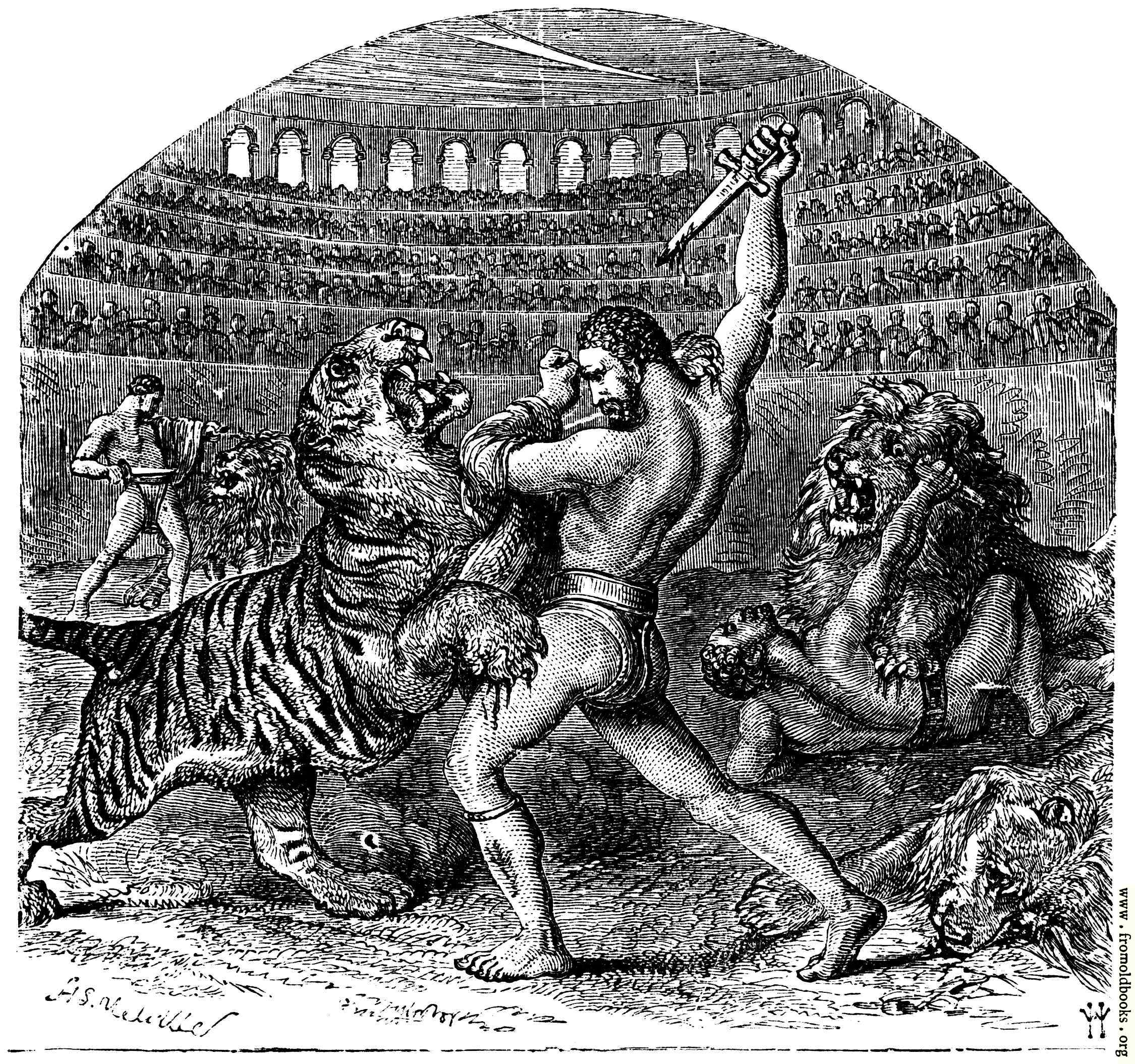
Everyone seems to be debating about the status of bullfighting, and while reading Candide I thought of it, so I might as well just say my opinion. The Romans had fun watching gladiators fight each other or in some cases with animals. Even though it started as a way to humiliate prisoners while the elite had fun, it became an opportunity for these prisoners to move up the social ladder, if they survived. Romans built coliseums all over their territory where, though they had a fancy structure, saw people kill each other in the most sanguinary and savage way. They even brought up exotic animals from their colonies, like elephants, lions, tigers or rhinoceros. The demand for these colossal and imposing grew so much that animals like the European lion became luckily extinct, or near to be in other cases. The Roman Empire ended and its culture dissolved into into its territories as each became its own nation.
Gladiator fighting a tiger in a coliseum

While man-to-man gladiators stopped existing, the culture of watching people or animals die and suffer remains up to the present. Candide and Lady Cunégonde end up living in Portugal while the Inquisition was still strong. They witnessed the death of their friend and teacher Pangloss in an auto-da-fé. The story of how that happened is told in the perspectives of both, Candide and Cunégonde. On one side, Candide saw how innocent people were captured by the Portuguese authorities for the sake of having a killing. He was wounded but Pangloss was killed. On the other side, Cunégonde was invited to an honoring seat at the execution where she could enjoy of refreshments. Anyway, when she realized that Pangloss was being killed, everything changed and she felt horrible. The Spanish and Portuguese Inquisitions were the outcome of a lot of things going on at that time, but what opened up the opportunity for it to happen was the savage foundations of these cultures.

People observing an auto-da-fé in a town's plaza

In an auto-da-fé heretics were burned usually in the town's plaza as everyone watched and enjoyed. Prisoners sometimes held symbols on their clothes to represent the crimes that had committed. People who went to the ceremony had a feast where they celebrated their Catholicism and culture. Thankfully this doesn't happen anymore but bullfighting does. Although these two things are almost incomparable as one includes religious and political persecution to humans while the other only includes bulls, but they do have similar customs and past. Bullfighting has a similar ceremony to that of a gladiator or an auto-da-fé. People gather around a plaza-like structure where they celebrate, socialize and enjoy a passion. The Roman elite yelled with emotion and what they said could influence what the gladiators did. In bullfighting people can ask the bullfighter to let the bull live in a similar way. People defend bullfighting saying that it is an art, a passion, part of their culture. That sounds to me similar to the acts of faith or auto-da-fé of the Inquisitions, where people went to honor their religion and preserve their culture, as the heretics were damaging it. Bullfighting has an overbearing tradition of procedures and symbols or whatever, as did the Spanish Inquisition.

A man fighting an animal in a plaza. Sounds similar? 
Recently the new mayor of Bogota, Gustavo Petro, threatened to make bullfighting illegal. I don't sympathize with many of his ideas, but I do with this one. He won't probably carry out his idea, as since he became mayor all he's done is to threaten to do unconventional things in order to raise attention and, in the biased way I see it, to cause social instability to make him raise in politics as a populist. Bullfighting fanatics come up with a lot of arguments, but all I think is that since the Spanish Inquisition or gladiators were cruel and simply bad, they shouldn't have any heritage. We shouldn't celebrate the killing of an animal, even if that creates an industry and the existence of the animal. Bulls are better off unborn than killed for the sake of entertainment. I don't mean to be offensive but the pro-bullfighting arguments have logic as good as the Inquisition had, where they though killing people would prevent an earthquake, like in Pangloss' case.
Your argument is invalid.

Thursday, February 9, 2012

Things Happen Because of Reasons

Voltaire's Candide targets mostly the way of living during the Enlightenment, such as feudalism and the illogical wars, but many of its critiques can be seen in the present world. Pangloss, for example, is portrayed as a great philosopher, but his ideas have no corroboration. Voltaire mocks his "metaphysico-theologo-cosmolo-nigology” as he says all things have been made for a purpose, such as legs, stones, pigs, among others. The philosopher even thinks that it was worth getting infected with syphilis because if it wasn't for Europeans to have gone to America and getting syphilis, they wouldn't have chocolate. He also says that an earthquake not only happens because of the sulphur but also that it is for the best. Other illogical things happen in the book, like accusations to make a war and religious agitations. People laugh while reading this, so Voltaire is a great satirist.
Maybe we think that these are stupid things that don't happen anymore, but these problems still exist and we're not laughing about it. Voltaire covers these problems with satire but in real life you don't get news edited into making people realize how illogical some conflicts are. People get discriminated because of their religion, religion causes people to attack others. People are accused as traitors in wars and required to fight. There's a lot of people who might not be philosophers like Pangloss but they have irrational ideas, like racism, homophobia, or xenophobia. The image below says, "observe that noses were made to wear spectacles," well now, observe that some people are simple inferior because they are. Life would be much more interesting if we satirized it all the time for it to look like Voltaire showed it, as the world has a lot of illogical ideas with a huge potential of satire.